
 LinkedIn
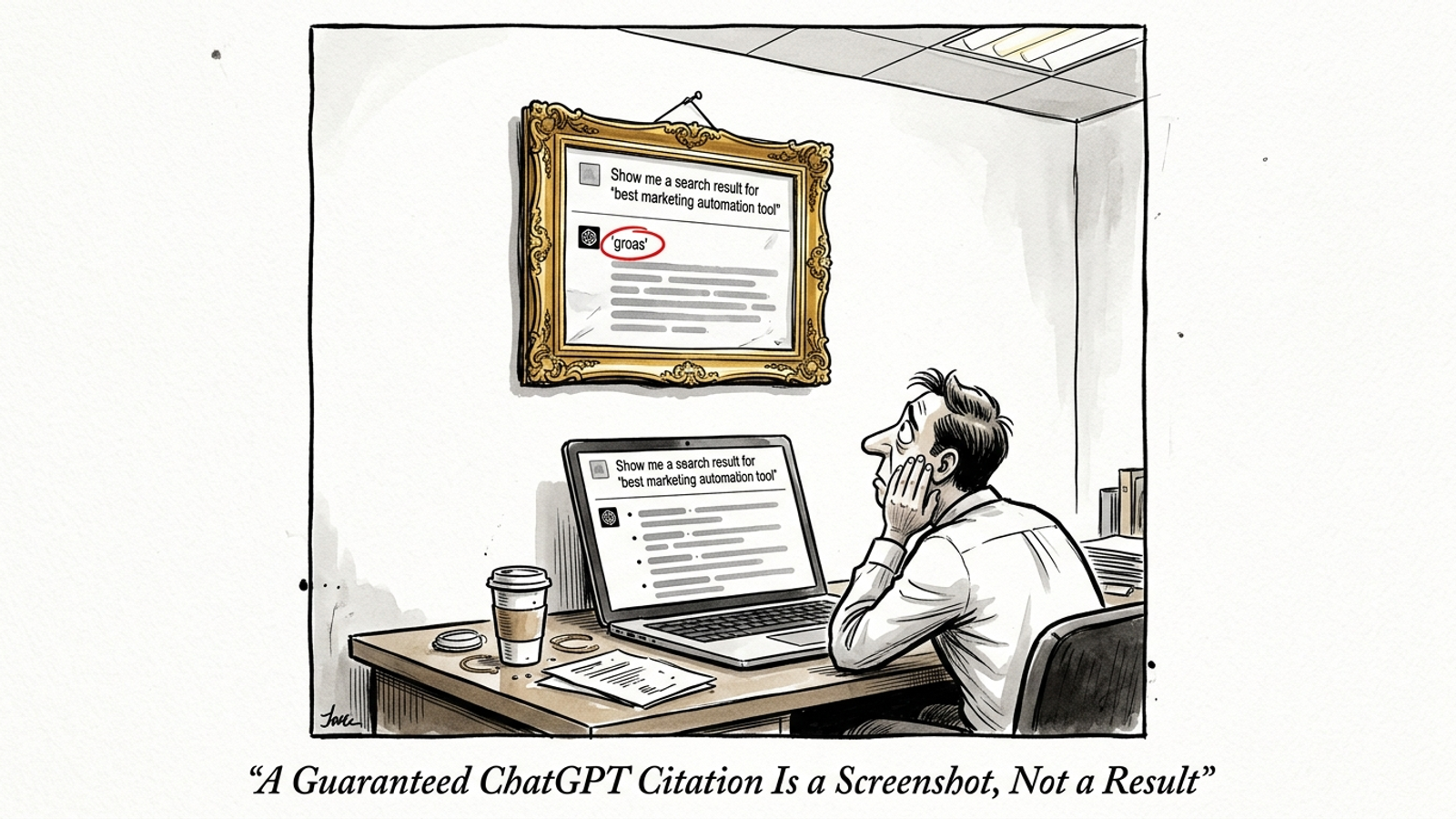
The “guaranteed AI citation” pitch is the 2015 “page one of Google guaranteed” pitch with a new logo. Now the proof is a ChatGPT screenshot from a cherry-picked prompt that may not reproduce tomorrow.
You know the email: “We guarantee your business cited in ChatGPT and Perplexity in 14 days.” Flat fee. Screenshot included. I got a version of it too.
I will save you the call. The screenshot can be real and still tell you nothing useful. Ask the same question five times and you can get five different lists. Ask the question a customer would actually type and you may get a sixth. A guarantee on one run is a guarantee on nothing.
I heard this pitch in 2015, only it said page one of Google. I was buying media back then and watched good owners pay for it. Same cherry-picked query. Same single snapshot. Same silence in month three.
One screenshot is one run, not a result
ChatGPT uses probabilistic token sampling, not a database lookup. Temperature, rounding, GPU parallelism, request batching: they all add variation, even at temperature zero. Run a prompt once and you have one sample from a distribution. You do not have a durable position on a shelf.
Run prompts at scale and the picture gets less flattering. One test of 2,961 queries found AI recommendation lists repeated less than 1% of the time. To look for a pattern, you need repeated runs per prompt, per platform. At 60 runs for each of 20 prompt variations across three platforms, that is 3,600 queries. The vendor ran one. He kept the good one.
That gap matters more than the polish of the report. A dated screenshot tells you what appeared under one set of conditions. It cannot tell you how often the name appears, whether a buyer would ask that question, or whether the answer survives a change of platform. Those are the questions you would be paying to answer.
The prompt was built to pass
Here is the trick: put your name in the question. “What does [Your Business] do for [Your Town]?” Of course you show up. On brand-name questions, 69.6% of citing responses cite the brand’s own domain. On “best” questions, the kind a buyer might type, that figure drops to 1.3%. That is a different test, not a slightly harder version of the same one.
Ask who chose the prompt. If the answer is the person selling the guarantee, you should see every prompt they rejected too. Otherwise the test begins after the vendor has decided what counts as a win.
“Cited” is doing suspiciously much work
A mention is not a citation, and a citation is not necessarily a useful link. You might appear in an answer without a link, get linked with the wrong description, or lose the spot to a competitor on the next run. The vendor calls all of it “visibility.” I call it three different jobs with one invoice.
Personalization makes the screenshot thinner still. The same query, asked twice in one afternoon, can return a different summary and different sources. Location, history, account signals, whatever tweak shipped that morning. A tracking guide puts the useful distinction plainly: citation rate across 30 queries checked weekly for two months tells you something. “Am I cited right now?” tells you almost nothing.
A screenshot records an appearance. It does not measure a rate.
The old page-one trick learned a new prompt
Google has long warned that no one can guarantee a number one ranking. No priority submit. No special relationship. Swap “ranking” for “citation” and the problem is familiar: the seller does not control which source the system picks on run number 47.
I used to tell clients exact match was control. I was wrong, but at least I logged the loss. The page-one guys never logged anything. They ranked you for “emergency plumber cheltenham johnson and sons ltd,” sent a screenshot circled in red, and renewed you at $1,500 a month. The guaranteed term had no buyers behind it.
The AI version guarantees a prompt containing your brand, your town, and your category spelled your way. Change four words to how a buyer talks, “invoicing tool for freelancers” instead of “billing software for solo designers,” and you may vanish. Change the model and you may vanish differently. One vendor breakdown ran the same prompt five times and got five different tool lists, with brands visible in Perplexity and invisible in ChatGPT. A pitch that hides phrasing and model variation is staging, not measurement.
Nobody sells a guaranteed organic slot because there is no slot to sell. There is no pay-for-placement in ChatGPT organic answers. Mentions can draw on training data and on whatever the retriever pulls live. Meeting technical requirements makes a page eligible; it does not guarantee that it gets crawled, indexed, or shown. Perplexity and Gemini publish no source-selection formula. Anyone selling a special relationship has the same one the page-one guys had. Imaginary.
The work behind a citation is dull. That is the point.
Real citation work has no screenshot moment. It starts with an audit nobody wants to pay for: schema, page structure, entities, and the gaps between your pages and the ones that keep getting picked. Then comes the dull rewrite. A Princeton and Georgia Tech study of generative search found that pages adding direct quotations, hard statistics, and cited sources lifted visibility scores by roughly 25 to 28 points over baseline. At scale, web mentions correlate with AI visibility far more than backlinks do. That means listicles, comparisons, Reddit threads, G2 profiles. Not a 14-day screenshot package.
There are fast levers and there is everything else. The fast part is unblocking GPTBot, ClaudeBot, and PerplexityBot in robots.txt and writing plain declarative sentences about what you sell and what it costs. Say you spend $20k a month on ads and your robots.txt file blocks half your product pages. Fix that first. There is no clever prompt that makes a blocked page easier to fetch.
The slow part is third-party corroboration. Some 43.8% of a 26,000-citation sample of ChatGPT answers pointed at “best X” listicles, most of them updated that year. Nobody guarantees their way onto those lists. You earn a mention, then wait to see whether it gets picked up. First make the page fetchable and useful. Then give the answer a reason to trust it.
Six questions before you sign
If a vendor cannot answer these on the call, there is no second call. Send the list back as your reply to the cold email and watch how fast the guarantee gets quiet. No stories here. Just the filter.
- Which prompts, chosen by whom? Get the full list before you pay. Buyer phrasing, not brand phrasing. If all ten contain your business name, they built the test to pass itself.
- How many runs, across which engines? Ask for a mention or citation rate across repeated runs on ChatGPT, Perplexity, and Google AI Overviews. Manual logged-out tracking of 20–30 queries weekly for eight weeks is enough to spot a pattern before you pay for a tool.
- What changes on my site and off it? The answer should name pages, schema, bot access, and the third-party lists and profiles they plan to pursue. “Secret AI hack” is not a work plan.
- Where is the log of work done? Every change, date-stamped, with its reasoning. No log, no proof anything happened after the screenshot.
- What happens in month three if nothing moves? Ask for the next lever, not a renewal invoice dressed as a strategy meeting.
- Can I cancel month to month? This is the item most vendors skip. Lock-in can cost you a year of retainer for screenshots that never reproduced. If they believe the guarantee, they should not need it.
Paid trackers have a place, but know what you are buying. Peec AI, Otterly, the Semrush AI toolkit, and Ahrefs Brand Radar can run hundreds of queries automatically at roughly $90–$300 a month. Useful once you have a baseline. Useless as proof that anybody changed the site. Most monitor whether you appeared; they do not change whether you appear next week. Do not make a five-figure decision off one week of dashboard confetti.
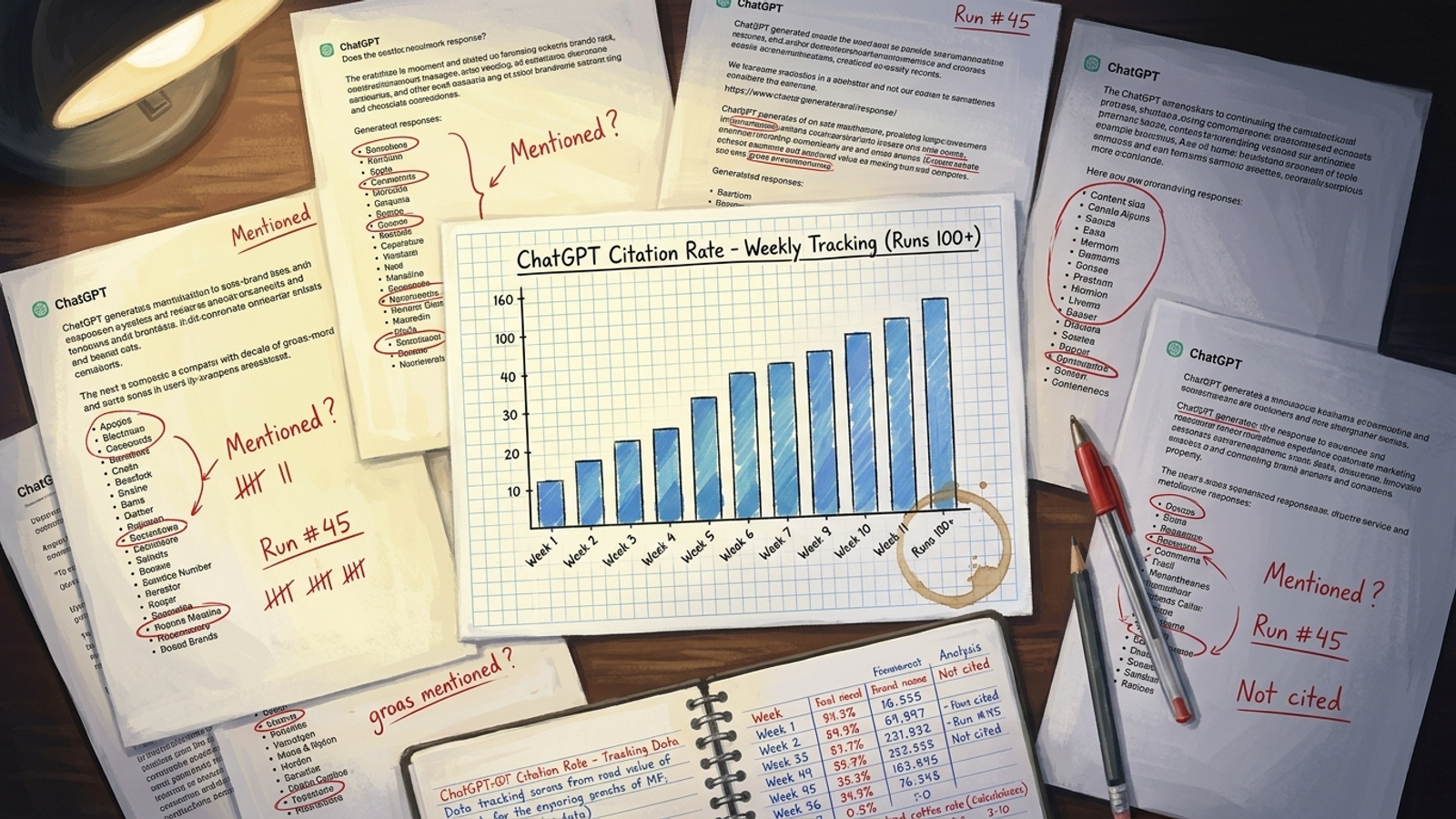
If you want that distinction spelled out, read the breakdown of tools that help you get featured in Google AI Overviews, not just monitored. Monitoring tells you whether a citation rate moved. The work gives it a chance to move: unblocking bots, rewriting a page into quotable sentences, fixing schema, earning a third-party mention. Selling only the first half is selling a speedometer with no engine.
Show me the work, then rerun the prompts
So what do I want instead of a screenshot? The conditions behind it. Be fetchable, be quotable, be corroborated. Let bots reach pages that render. Put the answer in plain sentences, with a number and a source where you have them. Pursue relevant mentions on pages you do not own. None of that lets you dictate the next answer. It does give you work you can inspect.
I run this boring version for clients inside groas. The difference is not a prettier screenshot. It is actions logged with their reasoning and month-to-month terms with no lock-in after the trial. Bots unblocked, schema fixed, page rewritten, prompt set rerun across engines. If the rate does not move, the log shows what we tried. For a look at the sales version of the alternative, read the AEO deck promising to get your client cited line by line. One side has to show work. The other can keep showing the same image.
Do the four-minute test before you reply to that email. Open a logged-out window. Run the vendor’s exact prompt three times. Then remove your brand name and run it again. Try a different engine. Watch the list reshuffle. Watch your name slide down or out. That is not you failing the test; it is the test revealing what it measures. A single run proved you could appear once under those conditions. The messy runs tell you more about what a buyer might see. They also give you a better question for the call: why did the vendor choose the tidy run instead?
I do not want another dashboard. I want the prompt list, run count, dates, and diff. Show me the robots.txt file before and after. Show me the sentence added to the page. Show me the listicle you pitched and whether the editor replied. Then rerun the same buyer prompts next week and show me the rate. The log is still there when the model changes. Tomorrow’s answer may not be.
This will not matter for everyone. If you serve one town, one trade, and ten searches a month, AI citations will not fill your calendar. Fix reviews, fix the profile, answer the phone. For the rest of you: buy a citation rate across buyer prompts, a log of pages changed and mentions pursued, and a contract you can leave. The vendor who will not sell you those three things has told you what he thinks his work is worth.
Keep the email. Frame the screenshot. It is the only result he could guarantee.